

What is Minerals Exploration Drilling?
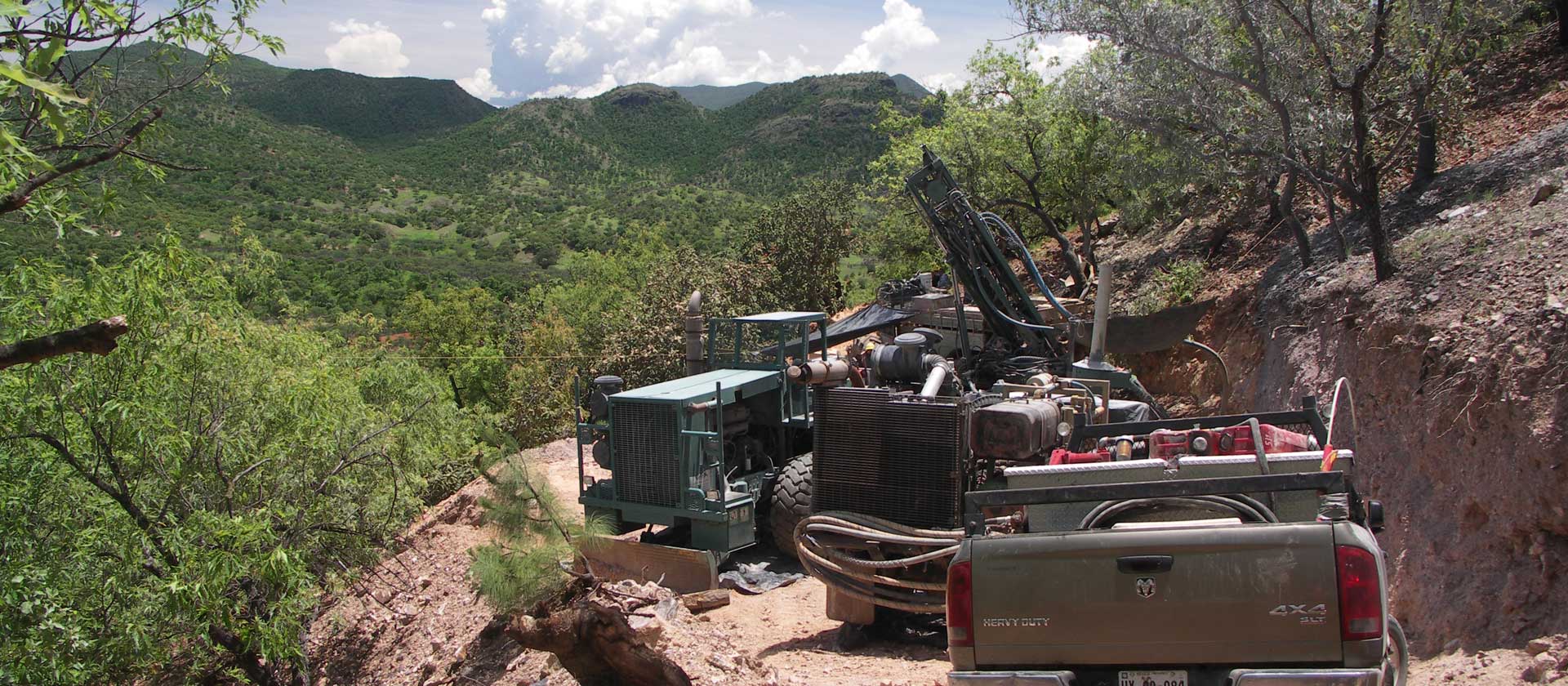
Minerals exploration drilling is used to investigate the subsurface geology of a prospect and determine the grade, geometry, and continuity of a mineral deposit. NorthStar supports two primary methods used in exploration programs worldwide:
- Diamond Core Drilling — A rotating diamond-impregnated drill bit cuts an annular slot through the rock, leaving a continuous cylindrical core sample inside the core barrel. The core is recovered to surface, logged, sampled, and analyzed for mineralization. Preserving core integrity and achieving maximum core recovery are the primary objectives of the fluid program.
- Rotary / Reverse Circulation (RC) Drilling — A tri-cone or hammer bit grinds the formation and compressed air (or water) carries drill chips up through the annulus or through the center of the drill rods to surface. RC drilling covers ground quickly and is used to define broader areas of mineralization before committing to core drilling programs.
Exploration drilling is typically carried out in remote or challenging environments — mountain ranges, tropical forests, deserts, and arctic regions — placing additional demands on the fluid system's performance and logistical simplicity.
Why Drilling Fluids Are Critical to Minerals Exploration

In exploration drilling, the value of the entire program depends on what comes back out of the hole. Poor fluid management leads directly to lost core, collapsed boreholes, and compromised samples — all of which waste time and money and can lead to incorrect resource estimates.
- Core recovery — Proper fluid reduces turbulent flow around the core barrel, minimizing erosion of soft or fractured core. Viscous, low-shear fluid systems gently transport chips without disturbing the sample.
- Borehole stability — In fractured, faulted, or weak formations, the fluid must stabilize the borehole wall to prevent collapse that blocks the core barrel or traps the drill string. Lost boreholes at depth can represent days of lost time and significant cost.
- Fluid loss control — In fractured or permeable zones, fluid loss into the formation reduces the hydrostatic head in the borehole and can cause collapse. Fluid loss control additives seal these zones and maintain circulation.
- Clay and shale inhibition — Reactive formations swell when contacted by fresh water. Polymer-based inhibitors prevent swelling clays from narrowing or closing the borehole, reducing stuck pipe risk.
- Lubrication — Deep exploration holes (sometimes exceeding 1,500 m) accumulate significant torque and drag. Lubricants reduce wear on the drill rods and bit, lower the risk of a stuck string, and improve penetration rates.
How NorthStar Supports Exploration Programs

NorthStar has supported exploration drilling programs in Canada, the USA, Colombia, and internationally — from gold and copper deposits to coal seams and industrial minerals. Our field team brings real experience in the conditions that exploration drillers encounter: fractured rock, variable water quality, extreme temperatures, and remote sites with limited supply access.
We supply PHPA polymers that provide both borehole stability and lubrication in a single product, as well as targeted fluid loss control agents, thinners for high-viscosity situations, and pipe-freeing agents for stuck string recovery. All of our products are designed to be simple to mix and use in the field, where sophisticated mixing equipment may not be available.
NorthStar can work with your geologist or project manager to recommend a baseline fluid program and then adapt as drilling encounters unexpected conditions. We understand that the core is the asset — our job is to make sure it makes it to surface intact.
Key Products
Recommended additives for minerals exploration drilling.